Why 100% Automated RCM Is Failing Practices, And What Actually Works
If you have been researching ways to modernize your practice's revenue cycle management, you have almost certainly encountered the promise of full automation. The pitch is seductive: deploy AI, eliminate human error, and watch your denial rates drop overnight.
The reality, as most experienced practice managers have learned the hard way, is considerably more complicated.
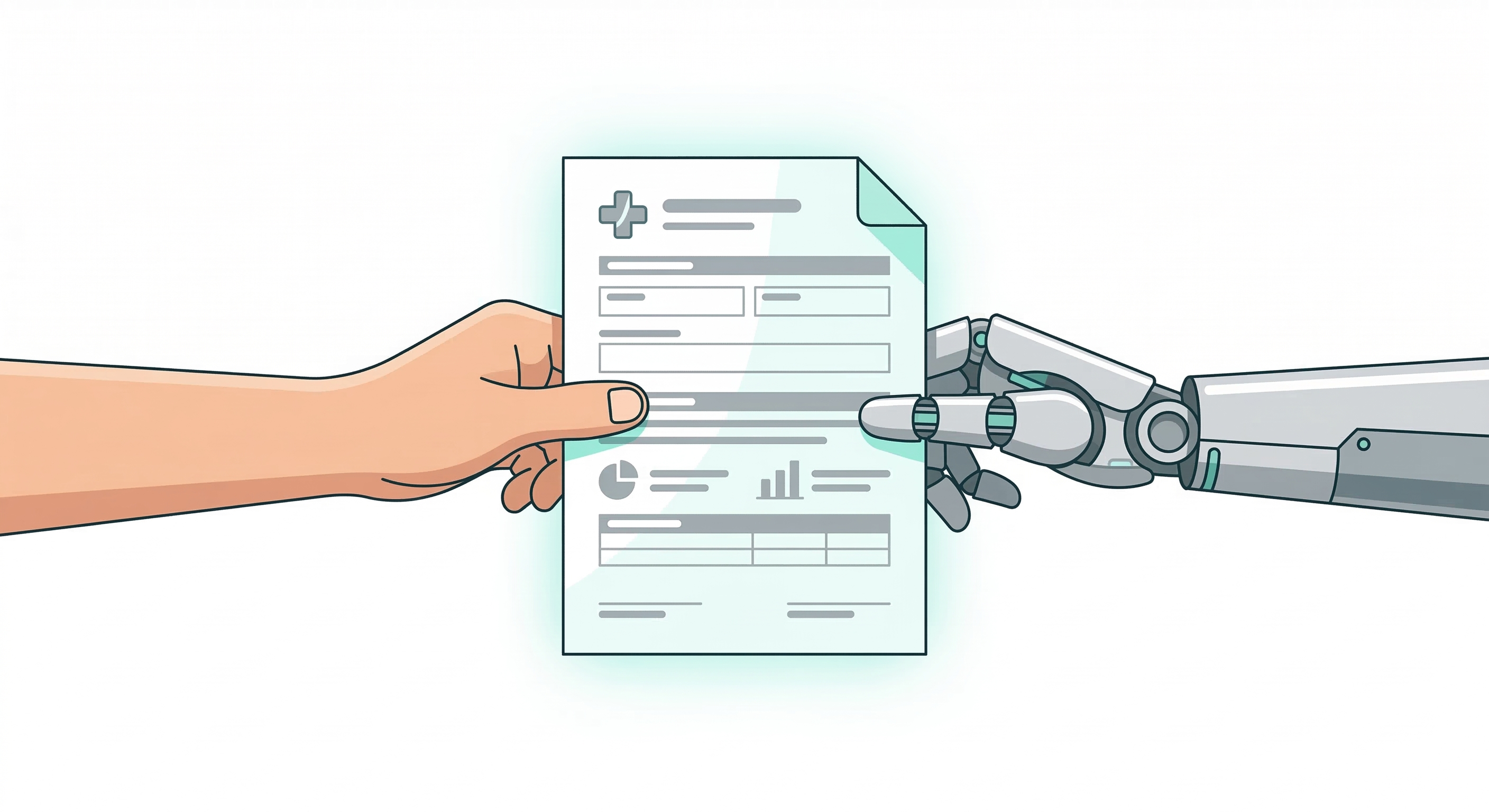
Yes, AI and Robotic Process Automation (RPA) are genuinely transforming RCM. But the practices seeing the best results are not those that replaced their billing teams with algorithms. They are the ones that restructured around a Hybrid Ecosystem, where AI handles scale and humans handle nuance.
This guide walks you through exactly how to make that transition: the model, the roles, the phased implementation, and the compliance guardrails you need to do it without disrupting cash flow or putting your team at risk.
Why Pure Automation Fails at the Worst Possible Moment
To understand the Hybrid model, you first need to understand where full automation breaks down and why those failure points happen to be the most expensive ones.
AI excels at pattern recognition across high-volume, structured data. For routine eligibility verification, standard ICD/CPT code suggestions, and claim submission queuing, it delivers consistent, fast, and cost-effective results. These are tasks where speed matters more than judgment.
But healthcare billing is not a uniform dataset; it is a living, shifting ecosystem shaped by:
- Payer-specific clinical documentation requirements that change without notice.
- Modifier logic for complex surgical claims that requires contextual reasoning.
- Diagnosis sequencing rules that vary by specialty, payer, and patient history.
- Medical necessity criteria that involve clinical judgment, not code matching.
When a claim hits one of these edge cases, a fully automated system does not pause and flag for review. It submits based on its training data, and the denial arrives weeks later, often past the optimal appeal window.
The most expensive denials are not the ones you catch. They are the ones the system processes confidently and gets wrong. A disproportionate share of those denials are in the complex, high-value claim categories where revenue leakage hurts most.
What the Hybrid Ecosystem Actually Looks Like
The Hybrid RCM model is not a compromise between automation and human labor. It is a deliberate division of responsibility built around what each does best.
The AI & RPA Layer: Scale and Speed
Robotic Process Automation handles every task where volume, speed, and consistency matter more than judgment:
- Automated eligibility and benefits verification prior to appointments.
- Routine ICD-10 and CPT code suggestion based on clinical documentation.
- Clean claim submission and real-time scrubbing against payer edits.
- Payment posting and ERA reconciliation.
- Automated follow-up on aging claims within standard payer timelines.
The Human SME Layer: Judgment and Strategy
Your human medical coders and billing specialists are elevated into Quality Auditor and Denial Strategist roles. Their work shifts from repetitive data entry to high-value oversight:
- Auditing AI-generated codes on complex, high-value, and specialty claims.
- Managing payer-specific denials that require clinical documentation review.
- Monitoring payer policy changes and updating coding protocols accordingly.
- Handling appeals that require written clinical justification.
- Identifying systemic denial patterns and correcting upstream documentation issues.
This is not a reduction in your team's importance; it is an upgrade in their function. The coders who spent their days processing routine claims now spend their time on the work that actually protects your revenue.
Case Study: Mid-Size Orthopedic Practice A 12-physician orthopedic group was processing approximately 3,200 claims per month with a billing team of 7. Their denial rate had climbed to 8.4%, with the majority of denials concentrated in surgical claims involving modifier combinations for bilateral procedures and staged surgeries.
After restructuring to a Hybrid model over a 90-day period (deploying RPA for routine tasks while retraining three coders as Quality Auditors focused specifically on surgical claim review) their denial rate dropped to 3.1% within six months. Net collections improved by an estimated $340,000 annually, and average days in A/R decreased from 38 to 26 days. Critically, no staff were eliminated.
The Step-by-Step Transition Blueprint
Here is how to move from your current billing model to a Hybrid Ecosystem without disrupting cash flow or exposing your practice to compliance risk.
Phase 1: Audit and Baseline (Weeks 1 to 3)
Before you change anything, you need to understand where your revenue is actually leaking.
- Pull your denial data for the past 12 months and categorize by reason code, payer, and dollar value.
- Identify your top 3 to 5 denial categories to become your human audit priorities.
- Baseline your key metrics: denial rate, first-pass resolution rate, days in A/R, and net collection rate. You need these numbers to measure your transition's impact.
Phase 2: Technology Selection and Configuration (Weeks 3 to 8)
Evaluate vendors against strict criteria:
- Native integration with your practice management and EHR systems.
- Configurable rules engine that allows you to define payer-specific logic.
- Audit trail and reporting that gives your Quality Auditors full visibility into AI decisions.
- HIPAA Business Associate Agreement with clear data handling and breach notification terms.
Pro Tip: During configuration, do not automate your highest-denial claim categories yet. Start with your cleanest, most routine claim types and expand incrementally as you validate accuracy.
Phase 3: Team Restructuring and Training (Weeks 6 to 10)
This phase is where most transitions succeed or fail. The technology is rarely the problem; change management is.
- Communicate early and clearly so your billing team understands this transition is about elevating their roles, not eliminating them.
- Identify your Quality Auditor candidates by looking for your most experienced coders, particularly those with deep knowledge of your top payers and specialty-specific coding rules.
- Define clear escalation protocols. What claim types always require human review before submission? Document these workflows so they are not dependent on institutional memory.
Phase 4: Go-Live with Parallel Processing (Weeks 10 to 16)
Run your automated and manual processes in parallel for a minimum of four to six weeks before fully transitioning.
- Compare AI-generated codes against your QA team's independent review on a sample of 100 to 200 claims per week.
- Track discrepancy rates by claim type to identify where the AI needs rules adjustment.
- Monitor your denial rate in real time. Any increase above your baseline is a signal to slow the transition and investigate.
Phase 5: Optimize and Expand (Month 4 Onward)
Once your baseline denial rate is stable or improving, you can begin expanding automation.
- Use denial data from your QA team to train your rules engine. Patterns your human auditors catch repeatedly should be codified into automated flags.
- Build a monthly review cadence where your denial strategists present pattern findings to clinical leadership. The best denial prevention happens upstream in documentation, not downstream in billing.
HIPAA Compliance in a Hybrid RCM Environment
Introducing new technology into your billing workflow creates new compliance obligations. Here are the non-negotiables:
- Execute a signed Business Associate Agreement (BAA) with every vendor whose platform touches PHI.
- Conduct a Risk Analysis before go-live that includes your new automation platform as a component of your ePHI environment.
- Apply minimum necessary access standards to your automation platform. The system should only access the data fields required to perform its function.
- Maintain audit logs for all automated claim processing to demonstrate who or what accessed any given patient record.
- Include your RCM automation platform in your annual HIPAA Security Risk Review.
Managing the Human Side of the Transition
Practice managers often underestimate how much of a Hybrid RCM transition is a people challenge rather than a technology challenge.
- Be specific about what is changing and what is not. Vague communication breeds anxiety. Tell your team exactly which tasks will be automated and which roles will evolve.
- Involve your experienced coders in the configuration process. They know your payers and your physicians' documentation habits better than any vendor.
- Frame the QA role as a promotion, not a reassignment. Quality Auditor and Denial Strategist roles carry more responsibility and should reflect that in your title structure.
Final Thoughts
The practices and hospitals winning on revenue cycle right now are not the ones that automated everything. They are the ones that were thoughtful about what to automate and strategic about what to protect with human expertise.
A Hybrid AI/Human RCM ecosystem is not a temporary workaround while AI catches up. It is the architecture that makes sense for a billing environment as complex, regulated, and high-stakes as healthcare. The AI handles volume. Your team handles judgment. Together, they handle revenue.
Let’s talk about building a Hybrid RCM strategy that actually pays off.
Connect with us today at solutions@irevmed.com or book a consultation at www.irevmed.com/contact.